FC03 Geely's new BHE15 i-HEV Intelligent Hybrid Engine
Geely i-HEV & the 48.41% Engine — A Technical Reading for EV Undergrads
Three approaches to tackle this: 1. pro-idea, 2. playing the devil's advocate and separate fact and marketing terms, 3. an objective and unbiased conclusion — with enough background to follow every claim.
0. Primer (skip if you already know this cold)
Before we judge whether Geely's 48.41% number is revolutionary, you need four ideas locked in.
0.1 Brake Thermal Efficiency (BTE)
BTE = useful mechanical work delivered at the crankshaft ÷ chemical energy in the fuel burned.
- A typical naturally-aspirated gasoline engine: ~25–30% peak, ~15–22% average over a drive cycle.
- A modern turbo direct-injection engine: ~35–38% peak.
- Toyota's Dynamic Force hybrid Atkinson: ~41% peak.
- Diesel passenger engines: ~42–45% peak.
- Large marine two-stroke diesels (Wärtsilä RT-flex96C): ~52% — the current production ceiling for any combustion engine, full stop.
- Geely BHE i-HEV: 48.41% peak. That puts a 1.5L gasoline engine within striking distance of slow-revving diesel ship engines. That is the headline.
The other 52% leaves the engine as heat (exhaust ~30%, coolant ~15%, radiation/oil ~7%). Every percentage point you claw back from one of those buckets is hard-won.
0.2 Hybrid topology — the P0–P4 nomenclature
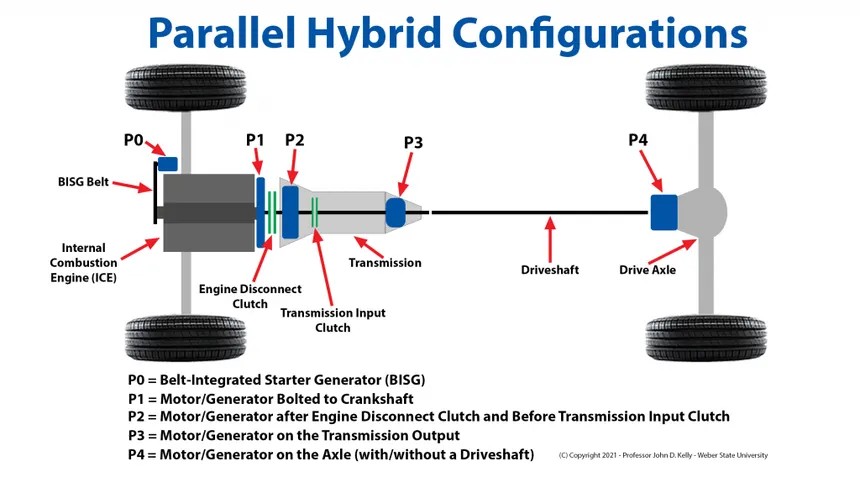
Where the electric motor sits relative to the engine and transmission defines the architecture. Memorise this:
| Position | Location | Function |
|---|---|---|
| P0 | Belt-driven off the engine accessory belt | Mild hybrid, start-stop, regen-lite |
| P1 | Directly on the crankshaft, before the clutch | Generator + torque assist; cannot decouple from engine |
| P2 | Between clutch and transmission input | Can drive in EV mode with engine off |
| P3 | On the transmission output shaft | Drives the wheels directly through the final drive |
| P4 | On the opposite axle (no mechanical link to engine) | Electric AWD |
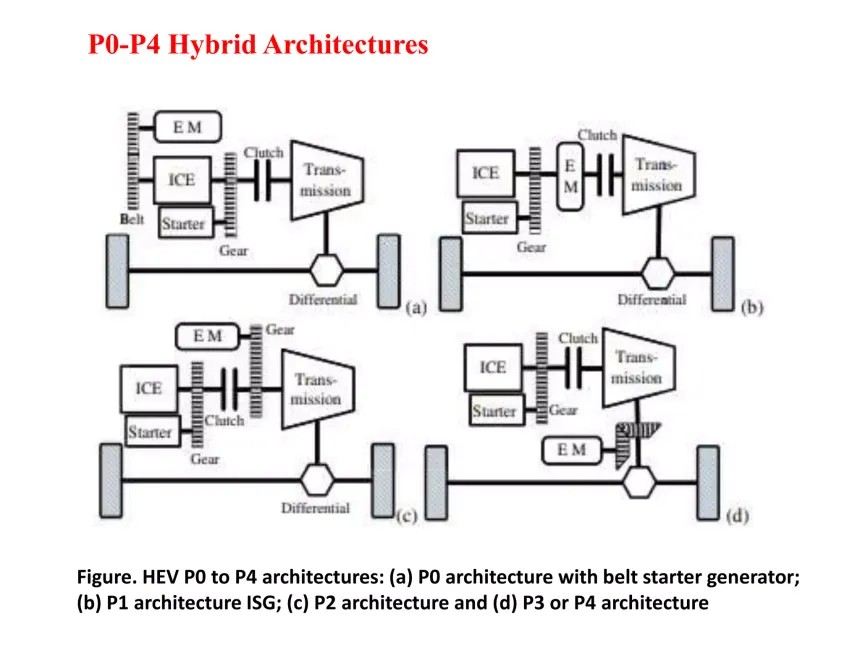
Geely i-HEV is P1 + P3. P1 is the generator bolted to the engine — its only job is to convert engine power into electricity. P3 is a drive motor that powers the wheels. The engine never directly drives the wheels unless a clutch in the 3-speed DHT (Dedicated Hybrid Transmission) engages.
This is functionally the Honda e:HEV / BYD DM-i pattern, but with a multi-speed gearbox instead of a single ratio. Toyota's THS uses a power-split planetary gearset instead — different solution to the same problem.
0.3 Series vs parallel vs series-parallel — the practical difference
- Series hybrid: Engine → generator → battery/inverter → motor → wheels. The engine never touches the wheels. Pros: engine always runs at peak efficiency. Cons: every conversion step costs ~3–5% (gen × inverter × motor × reducer ≈ 87% chain efficiency). Brilliant in stop-go traffic; loses to a direct mechanical link at steady highway speeds.
- Parallel hybrid: Engine and motor both connect mechanically to the wheels. Pros: no conversion losses at cruise. Cons: engine is forced to whatever rpm/load the road demands.
- Series-parallel: Switches between the two depending on conditions. This is what Toyota THS, Honda e:HEV, and Geely i-HEV all are. The cleverness is in how and when you switch.
0.4 Miller cycle (and Atkinson)
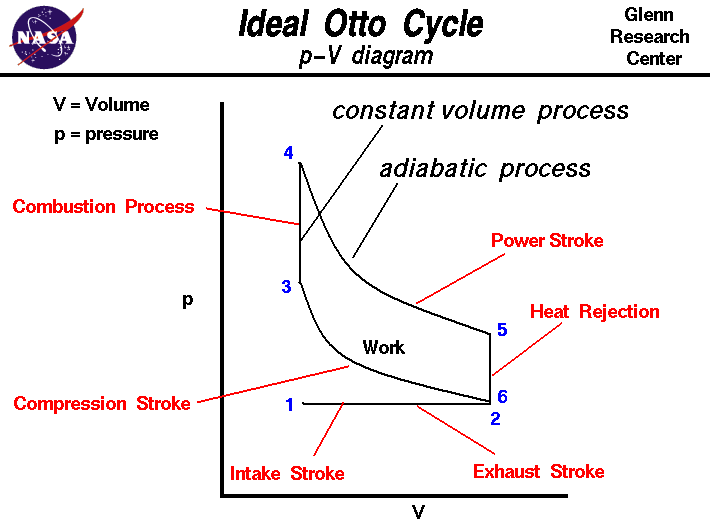
A normal Otto-cycle engine has equal compression and expansion strokes.
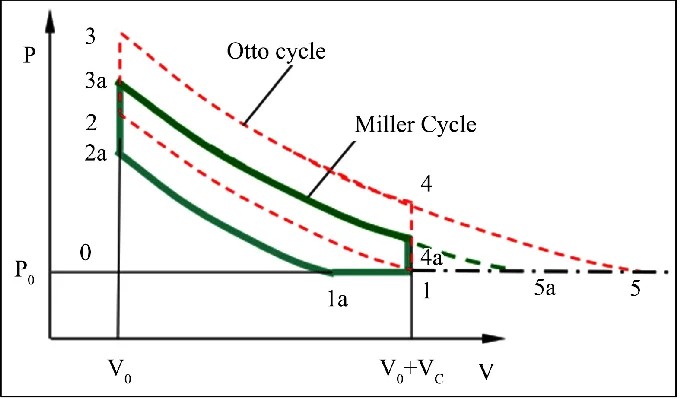
The Miller cycle (and its cousin Atkinson) closes the intake valve late so that some air is pushed back out before compression begins. Net result:
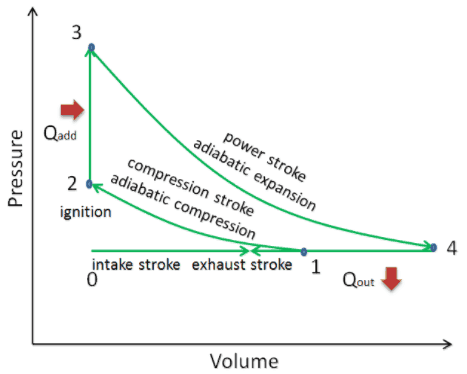
- The effective compression stroke is shorter than the geometric compression ratio implies.
- The expansion stroke is unchanged — so you extract more work from the high-pressure burned gases.
- Less work in compression + same work out in expansion = higher thermodynamic efficiency.
- Cost: less air trapped per cycle = less power for a given engine size. You can claw it back with a turbocharger (Miller) or accept it and let the hybrid system fill the gap (Atkinson, Toyota's approach).
Geely runs a geometric CR of 15.5:1 — extremely high for a gasoline engine — but the effective CR is lower because of Miller timing. The full expansion ratio is what gives them the efficiency; the late-intake-close is what lets them survive without knocking.
1. What Geely actually built
1.1 The engine — "Fire Tornado" combustion system
Geely's marketing name is a little trivial or dramatic. The engineering is not, it's quite sound. Specs:
| Parameter | Value | Why it matters |
|---|---|---|
| Geometric compression ratio | 15.5:1 | Very high; more expansion work per cycle |
| Stroke/bore ratio | 1.39 | Long-stroke; less surface area per swept volume → less heat loss to walls |
| Peak injection pressure | 500 bar | Finer fuel atomisation → faster, cleaner burn |
| Ignition energy | 150 mJ | ~2× a normal coil; lights diluted/lean mixtures reliably |
| Valve timing | Miller cycle | Late intake close (see §0.4) |
| Intake port | Duckbill design | Generates high in-cylinder tumble (a vertical swirl) |
| Friction reduction | −16.3% | DLC coatings on pistons, precision-ground bores, low-viscosity oil |
How these work together:
- The duckbill intake port creates a strong tumble vortex — air rolls into the cylinder like a barrel turning end-over-end. As the piston rises, that organised tumble breaks down into fine-scale turbulence right at top dead centre.
- Turbulence = fast, complete combustion. A fast burn finishes before the unburned end-gas has time to auto-ignite (which would be knock). This is the only reason you can run 15.5:1 CR on 91/95 RON pump gas.
- The 500-bar injector sprays fuel that's atomised so finely it mixes near-homogeneously in the time available.
- The 150 mJ coil lights the dilute mixture (which may be diluted with EGR, exhaust gas recirculation, to drop in-cylinder temperatures and further suppress knock).
- The high stroke/bore reduces the cylinder's surface-area-to-volume ratio at TDC — less hot gas in contact with cold metal means less heat lost to the cooling system.
- The Miller timing means the long stroke does mechanical work over the full expansion range while the effective compression is moderated.
- The −16.3% friction reduction is brute-force engineering: DLC (diamond-like carbon) coatings cut piston-ring friction; low-viscosity 0W-16 oil cuts pumping losses in bearings.
None of these is a new idea. Mazda Skyactiv has used high CR and tumble ports for a decade. Toyota's TNGA engines use Miller timing. VW EA888 uses split cooling. 500-bar GDI is on the Mercedes M139. DLC coatings are on every M-power BMW. What's new is running every single one of these at their aggressive setting simultaneously, and having the hybrid system mask the drivability penalties.
1.2 Dual (split-circuit) cooling
A conventional cooling system runs one thermostat and one circuit through both the block and the head. Split cooling runs two independent circuits at two different target temperatures:
- Block: hot, ~100–105°C. Hotter block oil → lower viscosity → less friction.
- Head: cooler, ~85–90°C. Cooler head = cooler intake charge = lower knock tendency = can run higher compression.
You essentially get two contradictory goals at once. Geely combines this with the EGR cooler and intercooler for a tightly controlled charge-air temperature, which is the third lever in their knock budget.
Again — not new (VW, Mazda, Toyota all do it) — but matched to a 15.5:1 CR engine that needs every °C it can save on the head side.
1.3 The hybrid powertrain — P1+P3 with 3-speed DHT
This is the architectural choice that makes the whole thing work in the real world.
Operating modes:
| Mode | When it activates | Powertrain state |
|---|---|---|
| EV only | Low load, low speed, battery has charge | Engine off, P3 motor drives wheels from battery |
| Series (engine off-axis) | Medium load, transient demand | Engine drives P1 generator → electricity → P3 motor → wheels. Engine kept at peak-efficiency rpm regardless of road speed |
| Direct drive (parallel) | Sustained highway cruise, total demand ~50–80% | Clutch engages, engine drives wheels mechanically through one of 3 DHT ratios. P3 may add boost |
| Full power (parallel + electric assist) | Heavy acceleration, >80% total system output | Engine direct-drives + P3 motor adds maximum torque + battery dumps power |
Why 3 speeds matter: A single-ratio DHT (like Honda's e:HEV) can only engage direct drive in a narrow vehicle-speed window. Outside it, you're stuck in series mode eating the ~13% conversion loss chain. With 3 ratios, you can keep the engine in its 48% efficiency island across a much wider road-speed band — say 60–140 km/h instead of 90–120 km/h.
This is the single biggest reason real-world fuel economy should hold up better than Honda's or Nissan e-Power's at highway speeds, where pure series hybrids lose their advantage.
1.4 AI Cloud Power energy manager
The energy-management strategy is the brain that decides which mode to run at any moment. Toyota's THS uses a rules-based state machine — basically a big if-else tree. Geely claims a learned policy that takes altitude, ambient temperature, humidity, traffic, driver behaviour as inputs and rebalances the engine-vs-electric split in real time. Geely claims +10% overall energy efficiency from this layer alone. Treat that as a sales figure until independently tested, but the direction is correct — energy management is one of the last big optimisations left in this architecture.
1.5 Production numbers — what the cars actually get
| Vehicle | Engine | Fuel consumption (WLTC) | Hybrid system power |
|---|---|---|---|
| Emgrand i-HEV (Guinness test) | 1.5L | 2.22 L/100 km (controlled course) | — |
| Preface i-HEV (Xingrui) | 1.5TD | 3.98 L/100 km | 230 kW (313 hp) total |
| Monjaro i-HEV (Xingyue L) | 1.5TD | 4.75 L/100 km | 230 kW (313 hp) total |
Pricing for the Monjaro starts around $19,600 USD in China. That's gasoline-SUV pricing for a hybrid with a Guinness-certified engine.
1.6 The body-on-frame off-road platform (separate announcement)
Don't conflate these. At Auto China 2026 Geely also unveiled a new-energy off-road architecture for the Galaxy Cruiser 700 / Battleship 700:
-
Body-on-frame chassis (ladder frame, traditional truck construction)
-
Tri-motor layout: one P3 at the front axle, two in-wheel P4 motors at the rear
-
1,000 hp combined, sub-4s 0–100 km/h
-
~50:50 weight distribution, double-wishbone suspension both ends
-
Dedicated off-road thermal management
-
Plug-in hybrid (battery ≥50 kWh) — different from the i-HEV passenger-car system
The off-road platform is its own engineering story (in-wheel motors on a ladder frame is genuinely uncommon — unsprung mass and durability are the usual blockers). It does not use the 48.41% engine; it uses a different PHEV powertrain. Marketing has bundled the two for the same press cycle, which is what created the confusion.
2. Pro-idea case — why this is a real step forward
The combustion efficiency leap is mass-produced and verified. 48.41% is not a research-lab number; it's running in cars you can buy. The prior production benchmark (Toyota Dynamic Force, Nissan e-Power) sat at ~41–42%. Geely jumped that by ~6 percentage points. In an industry where 0.5% gains are celebrated, this is large.
The architecture is genuinely better than the competition at the regime where hybrids usually lose. Honda e:HEV and Nissan e-Power are essentially pure-series hybrids with a single mechanical-drive lockup that only engages in a narrow speed band. Geely's 3-speed DHT plus P1+P3 gives them a wider direct-drive window, which is where real-world highway fuel economy is decided. Combined with the AI energy manager, the average drive-cycle efficiency should sit closer to the 48% peak than any prior production hybrid — perhaps 42–45% averaged across mixed driving, versus Toyota's ~36–38%.
The economics matter more than the engineering. A 48% engine in a $20k SUV is the disruptive event. Toyota and Honda will respond, but their architectures need fresh investment to match — and they can't simply badge-engineer this; the 15.5:1 CR Miller engine needs the matching split cooling, the 500-bar injection, the 150 mJ ignition, and the P1+P3 DHT around it. Three to five years of catch-up at minimum.
Peak efficiency is reachable more often than usual. A conventional engine touches its peak BTE only at one operating point during steady cruise. The i-HEV architecture is engineered to park the engine at that point any time it's running — that's the entire purpose of the P1 generator and the 3-speed DHT. So while peak efficiency is still narrow in rpm/load terms, it's broad in time spent at peak. That changes the peak-vs-average gap meaningfully.
The AI energy manager is the only piece that's genuinely novel. Everyone else uses rules-based control. A learned policy that adapts to altitude/temperature/driver style is the last big optimisation lever in this architecture and Geely is first to ship it at scale.
3. Devil's advocate — the dismissive case
Peak BTE is a marketing metric. It exists at one specific (rpm, load, coolant temp, intake temp, ambient pressure, fuel quality) point. Move 15% in any axis and you're at 44–46%. The engine spends real-world minutes cold-starting (~15–20% BTE for 2–3 minutes), thermal-cycling on/off to maintain battery SOC (warm-up penalty taken repeatedly), and operating off-peak when the battery is full or empty. The 48.41% number describes a tiny island.
Series-hybrid losses don't disappear. When you're in series mode (which is most of city driving): engine 48% × generator 96% × inverter 98% × motor 95% × reducer 98% = ~42% wheel-side efficiency. That's good, but it's not 48%. Toyota's THS at parallel cruise reaches ~38% wheel-side with much simpler hardware and lower BOM (Bill of Material - details specifications and number of parts) cost.
The 2.22 L/100 km Guinness result is theatre. That was the smallest, lightest model (Emgrand) on a course optimised for the result. It's the powertrain equivalent of a hypermiling stunt. Anchor on WLTC instead — and even WLTC is an optimistic procedure.
Your real-world expectation should be wider than 5–10%.
- WLTC underestimates real-world consumption for hybrids by 15–25% (EPA Combined typically runs 20–30% worse than NEDC; WLTC is in between).
- Reason: WLTC has gentle accel/decel profiles that perfectly suit electric assist. Real drivers do harder acceleration and don't coast as efficiently.
- Realistic projections:
- Preface i-HEV: ~4.7–5.2 L/100 km mixed (vs 3.98 WLTC)
- Monjaro i-HEV: ~5.5–6.5 L/100 km mixed (vs 4.75 WLTC)
- Cold climates / motorway-heavy use: add 10–20% on top
The technologies are all old. Miller cycle: 1957 patent. High tumble: Mazda Skyactiv, 2011. 500-bar GDI: Mercedes M139, 2019. Split cooling: VW EA888 evo3, 2015. DLC coatings: BMW M, 2010s. P1+P3 with multi-speed DHT: BYD DM-i, Great Wall Lemon DHT, 2021. Geely has integrated better than competitors, but no fundamental science is new here. The press will keep landing because the BTE number will keep ticking up — Geely's own previous record (47.26%) was less than a year old when 48.41% was announced.
Durability is unproven. A 15.5:1 CR engine on pump gas with 500-bar injection and DLC-coated pistons is stressed on every dimension a production engine can be stressed on. Honda and Toyota's hybrid engines hit 300,000+ km routinely because they're under-stressed. The i-HEV's failure modes will only show up at 100,000+ km of customer use, and the cars are weeks into delivery.
The off-road platform is unrelated. Mixing the 1,000 hp tri-motor truck platform into the i-HEV story is a marketing trick. The 48.41% engine doesn't power that truck; it's a different PHEV system. The truck's interesting (in-wheel motors on a ladder frame) but for completely different reasons — and in-wheel motors have a 20-year history of unsprung-mass and durability problems nobody has fully solved.
4. Objective conclusion
Both sides above are partially right. The honest synthesis:
What this is: an unusually disciplined system-level integration of well-understood technologies, delivered at mass-production scale at gasoline-equivalent pricing. The peak BTE record (48.41%) is real and Guinness-verified. The production cars deliver WLTC numbers (3.98–4.75 L/100 km) that are clearly best-in-class for their segment. No single component is novel; the integration is.
On peak vs average: peak BTE lives on a narrow rpm/load island, but the P1+P3 architecture is engineered to keep the engine on that island whenever it's running. Expect average combustion efficiency across a real drive cycle of roughly 42–45% — still meaningfully ahead of Toyota's ~36–38%.
On real-world fuel consumption: your 5–10% intuition is too generous. Plan on 15–25% worse than WLTC for typical mixed driving. That gives:
- Preface i-HEV: ~4.7–5.0 L/100 km (≈47–50 mpg US)
- Monjaro i-HEV: ~5.5–6.0 L/100 km (≈39–43 mpg US)
Even at those numbers, the Monjaro is ~30–40% more fuel-efficient than a comparable gas SUV and ~10–15% better than a Toyota RAV4 Hybrid. That's the actual delta to anchor on, not the 2.22 L/100 km headline.
Is it revolutionary?
- In physics: no. Every lever Geely pulls is in textbooks.
- In integration: yes. The bar for what a mass-market HEV looks like just moved.
- In economics: the most important point. A 48% peak BTE hybrid at conventional gasoline-SUV pricing is the disruptive event. Toyota and Honda have to respond, and the response requires architectural changes (multi-speed DHTs, split cooling, higher-pressure DI systems, AI energy management) that are not single-component upgrades.
For an EV undergrad, the takeaway is: combustion engineering is not dead. The combustion-engine learning curve still has 3–5 percentage points of BTE headroom (toward the ~52% diesel ship-engine ceiling) and another 5–10% available via better hybrid architecture and AI energy management. Pure-BEV proponents who declared ICE finished by 2020 were premature; the floor for "good enough" hybrid efficiency has just risen so high that battery-electric must compete on total cost and convenience rather than fuel-burn-per-km. That makes the next 5 years of this transition more contested, not less.